New Paintings
These new paintings for modern times treat the canvas as a flat plain on which colours and forms are clearly arranged. little attempt is made to create atmospheric space by moduation of the paint colour and tone, and accident is kept to a minimum.
Within the paintings there are games for the eye and the mind; visual paradoxes, puns and metaphors, deeply layered. This strengthens and indeed sustains them.
As in my earliest paintings of the 1960s, the chief compositional opportunity lies in the dichotomy between the monochrome drawing of halftone and the hard edge flatness of the coloured areas.
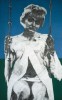
I can get more detail, more information, more drama and more mystery in the black and white passages which are literally paintings of newspaper photographs, and I tend to use them to convey emotionally charged ideas. They depend on optical effects, such as the persistence of the visual image on the retina, and our ability to understand certain visual conventions that are part of the shorthand of image transmission which we have learned in the modern environment. If you look closely at the cnvas, the surface disintegrates and becomes abstract, displaying its digital system of transmission; from further away, it resolves into an image. Both qualities are part of the painting; combined, they are unique to our age.
On the other hand, the coloured areas are stark, clear and sharp. They reiterate the fact that the paintings are flat, decorated surfaces, relating to what used to be called, but are no longer, the Italian primitives. in other words they are more like Cimabue and Uccello than Turner or Rothko. They are objects, not windows; icons, not landscapes. These qualities are abstract. They sustain the paintings and give them stamina.
To Discuss the content of these paintings is to enter another arena. |It is the role of the artist to reiterate humanist concerns by pushing aside the veil of history which, cobweb-like, obscures the living past, and comment on them for his generation. The paintings show us the dance of our own modern times, in a modern manner. The events are essentially commonplace, ordinary joys and sins, though their effect is often devastating.
Gerald Laing, 2008